
Cognitive Behavioral Therapy in Redwood City CA and Bay Area CA
CBT provides a practical framework for turning that understanding into action. Together with your therapist, you can identify patterns that are keeping a problem going, develop new ways of responding, and practice those changes in your everyday life.
At Beyond Measure, we provide cognitive behavioral therapy in Redwood City, CA and virtually throughout California. Our approach is collaborative and individualized, combining the structure of CBT with an understanding of your history, relationships, identity, environment, and goals.
CBT Therapy for Anxiety and Depression in Redwood City CA
CBT may be helpful if you are experiencing:
- Anxiety or excessive worry
- Depression or low motivation
- Panic attacks or specific fears
- Social anxiety
- OCD and obsessive-compulsive patterns
- Trauma-related symptoms
- Eating disorders or disordered eating
- Perfectionism and harsh self-criticism
- Chronic stress or burnout
- Procrastination or avoidance
- Sleep difficulties
- Relationship challenges
- Difficulty coping with life transitions
- Repetitive thought patterns that leave you feeling stuck
You may also seek CBT simply because you want practical tools for responding differently to situations that repeatedly create distress.
At Beyond Measure, we view these patterns with curiosity rather than judgment. Thoughts and behaviors are shaped by learning, experience, relationships, and the environments in which we live. CBT gives you an opportunity to understand those patterns and experiment with new responses.
Consider someone experiencing depression. They may feel exhausted and disconnected, begin withdrawing from friends and activities, and start thinking, “Nothing is going to change” or “I can’t do anything right.” Those thoughts can deepen hopelessness, making withdrawal feel even more necessary.
Anxiety can create a similar cycle. A person may worry that something will go wrong, avoid the situation, and experience immediate relief. That relief can teach the brain that avoidance works, making the next situation feel even more threatening.
The cycle can become self-reinforcing.
CBT helps you identify these patterns and look for places where you can respond differently. Sometimes that involves examining a thought or assumption. Sometimes it means changing a behavior, approaching something you have been avoiding, or creating a different routine.
The goal is not to control every thought or eliminate difficult emotions. It is to develop greater flexibility in how you respond.
Cognitive Behavioral Therapy for Lasting Change in Bay Area CA
CBT can help you recognize patterns such as:
- All-or-nothing or black-and-white thinking
- Catastrophizing
- Overgeneralizing from one experience
- Assuming you know what someone else is thinking
- Jumping to conclusions
- Excessive self-blame
- Discounting positive experiences
- Treating a possibility as a certainty
- Setting unrealistic expectations for yourself
The goal is not to replace difficult thoughts with artificially positive ones.
Instead, your therapist may help you ask:
- Is this thought accurate?
- Am I missing information?
- Am I treating a possibility as a certainty?
- Would I hold someone else to this same standard?
- Is there another way to understand what happened?
- What response would be most helpful right now?
For someone struggling with perfectionism, for example, CBT might involve examining the belief that making a mistake means they have failed. For someone experiencing social anxiety, therapy might explore the prediction that other people are constantly judging them.
Over time, practicing more flexible ways of thinking can make those responses easier to access.
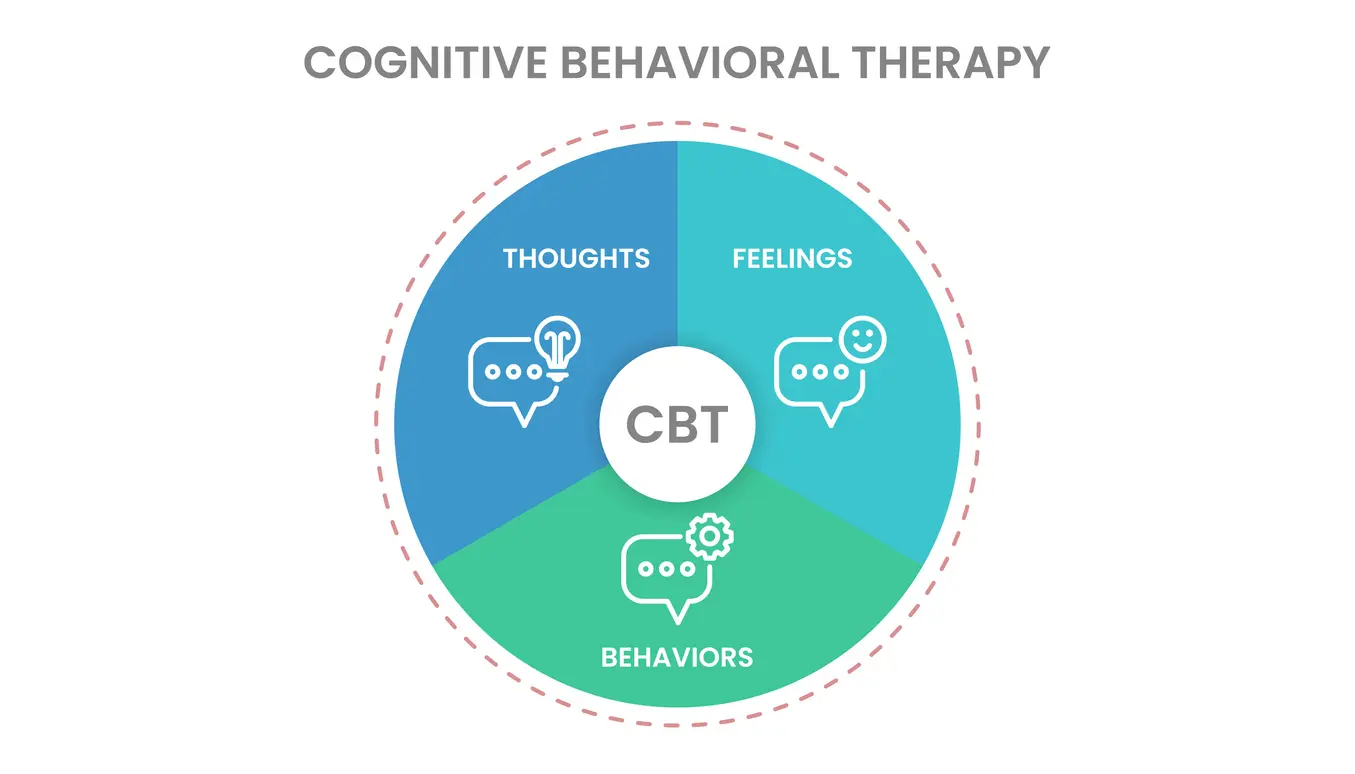
Behavior is a central part of treatment because what we do can reinforce the patterns that keep distress going.
For anxiety, behavioral work may involve gradually approaching situations that have been avoided.
For perfectionism, it might mean submitting something without checking it repeatedly or intentionally practicing a more realistic standard.
For chronic stress, it may involve setting a boundary, changing a routine, or making space for rest without treating rest as something that must be earned.
The goal is not to make sweeping changes overnight. Your therapist works with you to identify specific, manageable steps that can be practiced in real life.
When you avoid something frightening, uncomfortable, or uncertain, you often feel better in the short term. That relief makes avoidance more likely the next time the situation arises.
Over time, however, avoidance can make your world smaller.
CBT may incorporate gradual exposure to help you approach situations you have been avoiding. Exposure is not about forcing you into the most frightening situation or overwhelming you with distress. Instead, you and your therapist identify manageable steps and practice facing discomfort while reducing reliance on avoidance or safety behaviors.
Depending on your concerns, exposure might involve:
- Attending part of a social event
- Speaking in a meeting or classroom
- Completing an assignment without excessive checking
- Sending a message without repeatedly rewriting it
- Returning to a previously avoided activity
- Allowing uncertainty without repeatedly seeking reassurance
- Approaching a feared situation in gradual steps
The goal is not to make every uncomfortable situation feel easy. It is to help you learn that discomfort can be tolerated and that you can continue doing meaningful things even when anxiety is present.
Practical CBT Counseling With a Therapist in Redwood City CA
Anxiety and Panic
CBT can help identify worry patterns, avoidance, catastrophic predictions, reassurance seeking, and other behaviors that maintain anxiety. Treatment may include cognitive strategies, behavioral experiments, exposure, and skills for responding to physical symptoms of anxiety.
Depression
When depression leads to withdrawal, low motivation, hopelessness, or loss of interest, CBT may incorporate behavioral activation alongside work on thoughts and beliefs that contribute to the cycle.
Perfectionism and Self-Criticism
CBT can help people examine rigid standards, fear of mistakes, comparison, and beliefs that connect achievement with self-worth. Treatment may include practicing flexibility and experimenting with more realistic expectations.
OCD
OCD involves more than simply having anxious thoughts. When appropriate, treatment may incorporate specialized CBT approaches such as Exposure and Response Prevention (ERP), which helps people gradually face feared thoughts or situations while reducing compulsive responses.
Trauma-Related Concerns
CBT-based approaches can be adapted for trauma-related symptoms. Depending on the individual’s needs, treatment may focus on safety, coping, beliefs related to the experience, avoidance, and processing traumatic experiences through an appropriately paced trauma-informed approach.
Eating Disorders and Disordered Eating
CBT can be incorporated into eating disorder treatment to explore thoughts, behaviors, avoidance, and patterns that maintain eating disorder symptoms. At Beyond Measure, this work occurs within a size-inclusive framework that does not equate health, worth, or recovery with body size.
Stress and Life Transitions
CBT can also provide practical tools for navigating work stress, relationship challenges, major transitions, and other situations where old patterns may no longer be serving you.
CBT for Children
Children may not be able to explain their internal experiences in the same way adults can. CBT for children therefore often uses developmentally appropriate activities to help them identify emotions, recognize body sensations, understand worried thoughts, practice coping skills, and gradually approach situations they have been avoiding.
Parent involvement is also an important part of treatment. Caregivers can learn ways to reinforce skills and support their child’s progress outside of therapy.
CBT for Teens
Adolescence brings unique challenges related to independence, identity, school, friendships, family relationships, and increasing expectations.
CBT for teens may address anxiety, depression, perfectionism, social fears, academic stress, avoidance, trauma-related symptoms, and other concerns. Adolescents may learn to recognize thinking patterns, separate self-worth from achievement, approach difficult situations gradually, and develop practical strategies they can use at home, at school, and with peers.
Building trust is especially important in teen therapy. Adolescents need to feel respected and understood rather than lectured or treated as a problem to be fixed.
CBT for Adults
Adults may seek CBT for anxiety, depression, perfectionism, trauma-related concerns, relationship difficulties, work stress, chronic worry, or patterns that have developed over many years.
Treatment may focus on current challenges while also considering the experiences and relationships that helped shape those patterns. The goal is to develop tools that are useful not only during therapy sessions but in everyday life.
Sessions may include:

- Exploring a recent situation that created distress
- Identifying thoughts, emotions, physical sensations, and behaviors
- Recognizing patterns that maintain a problem
- Practicing new ways of thinking or responding
- Setting specific goals between sessions
- Completing behavioral experiments
- Practicing exposure when appropriate
- Building emotional regulation and coping skills
- Reviewing what worked and adjusting the treatment plan
CBT is collaborative. Your therapist is not simply giving you advice or telling you what you should think. Instead, therapy provides a space to examine patterns together, test new approaches, and learn from your experiences.
Some people benefit from structured between-session practice, while others need a slower pace or additional space to understand what is happening before making behavioral changes.
Evidence Based CBT Treatment for Clients Across Bay Area CA
At Beyond Measure, we tailor CBT to the individual rather than assuming the same protocol will work for everyone. We consider your symptoms alongside your history, relationships, identity, environment, strengths, and goals.
We also recognize that difficult emotions are not always the result of distorted thinking. Sometimes anxiety, sadness, anger, or overwhelm make sense in the context of what someone is experiencing.
Our therapists may integrate CBT with other evidence-based and trauma-informed approaches when appropriate, including mindfulness, acceptance-based strategies, DBT skills, trauma-focused interventions, and other therapeutic methods.
For clients whose mental health and nutrition concerns overlap, our multidisciplinary team can also coordinate therapy and nutrition support. This may be particularly helpful for individuals experiencing eating disorders, disordered eating, or food- and body-related concerns.
Our goal is to provide enough structure to create meaningful change while remaining responsive to the person sitting in front of us.
The goal is not to eliminate normal human emotions.
Instead, progress may look like:
- Recognizing an unhelpful pattern sooner
- Responding to thoughts without automatically believing them
- Recovering more quickly after setbacks
- Taking action even when motivation is low
- Spending less time avoiding situations because of fear
- Becoming more flexible with expectations
- Reducing reassurance seeking or checking
- Communicating more directly
- Developing greater confidence in your ability to cope
- Making decisions based on your values rather than fear
- Returning to activities and relationships that matter to you
Change is rarely perfectly linear. Stressful periods, transitions, or unexpected events can make old patterns resurface. CBT helps you develop skills that you can continue using when those challenges arise.
The goal is not to become someone who never struggles. It is to become more capable of recognizing what is happening and choosing how you want to respond.
What is Cognitive Behavioral Therapy?
Cognitive Behavioral Therapy, or CBT, is an evidence-based form of psychotherapy that explores the relationship between thoughts, emotions, physical sensations, and behaviors. Treatment focuses on identifying patterns that contribute to distress and practicing new ways of responding.
CBT is active and collaborative. Depending on your goals, sessions may include cognitive strategies, behavioral experiments, exposure, problem solving, skill building, and practice between sessions.
Is CBT only for anxiety and depression?
No. CBT has been adapted for many concerns, including anxiety, depression, OCD, trauma-related symptoms, eating disorders, insomnia, perfectionism, stress, and relationship difficulties. It can also be useful for people who do not have a formal diagnosis but want practical tools for changing recurring patterns.
Is CBT just about changing negative thoughts?
No. CBT is not about replacing every negative thought with a positive one or pretending that difficult circumstances are not difficult.
CBT considers both thoughts and behaviors. Sometimes changing how you interpret a situation is helpful. Other times, the most important change involves what you do—such as reducing avoidance, rebuilding routines, practicing a boundary, or approaching something you fear.
How long does CBT take?
The length of CBT varies depending on the concern, its severity and duration, your goals, and how you respond to treatment. Some people benefit from a relatively focused course of therapy, while others need longer-term support for more complex or longstanding concerns.
Your therapist can discuss treatment length and goals with you as therapy progresses.
Can CBT be used with children and teens?
Yes. CBT can be adapted for children and adolescents using developmentally appropriate language, activities, and strategies. Parent involvement may also be incorporated depending on the child’s or teen’s needs.
Do I have to have a diagnosis to start CBT?
No. You do not need to have a formal mental health diagnosis to seek CBT. Some people come to therapy because they feel stuck in patterns of worry, avoidance, perfectionism, self-criticism, or stress and want practical support for making changes.
How do I know whether CBT is right for me?
A consultation is a good place to begin. You do not need to determine the right treatment approach before reaching out. During an initial conversation, we can learn more about what you are experiencing, what you hope to change, and whether CBT or another approach may be appropriate.
Beyond Measure offers cognitive behavioral therapy in Redwood City, CA and virtually throughout California. Our therapists provide evidence-based, compassionate care while adapting treatment to your individual needs, developmental stage, experiences, and goals.
You do not have to figure out the pattern—or how to change it—on your own.
📞 Call: (650) 332-9583
🖥️ Book Online: Free 15-min Consultation
📩 Email: info@beyondmeasuresfbay.com
your healing journey today.